

















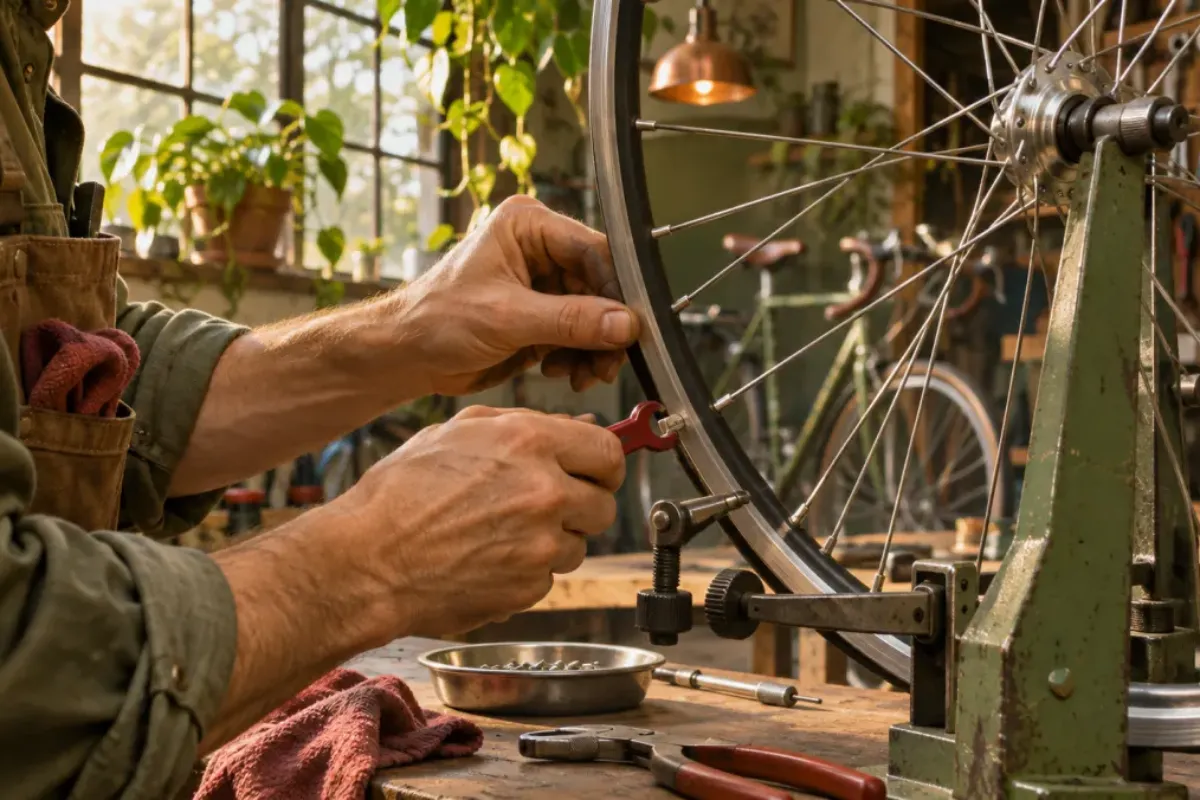
A Day in a Bicycle Workshop
· 8:58 · With Emma
Today, we’re stepping into a bicycle workshop—not to follow one universal routine, because every shop is different, but to see how a repair can bring together careful diagnosis,…
Transcript
EmmaWelcome to Slow English FM. This is A Day in the Life, where we explore what a job can involve through its everyday tasks. Today, we’re stepping into a bicycle workshop—not to follow one universal routine, because every shop is different, but to see how a repair can bring together careful diagnosis, practical work, and clear communication. A bicycle may arrive with a problem the rider can describe, but the cause may not be clear at first. The mechanic’s work can begin by listening and asking questions, then examining the bicycle to understand what is wrong. Diagnosis means finding the cause of a problem. It helps guide what happens next: the mechanic can discuss possible repairs and costs with the customer, and the customer can decide how to proceed. Some jobs may be straightforward, such as replacing a cable or a tire. Other work involving brakes, gears, or a frame can be more complex. These examples show the range of tasks, not a fixed order or ranking. The right approach depends on the bicycle and the fault. Technical repair guidance is often organized by component and repair type, rather than as one recipe that fits every bicycle. Parts can shape the work, too. If a needed part is not available, it may have to be ordered. The mechanic may also record relevant information about the job. Documentation means keeping a record of the work; along with booking jobs and managing stock, it can help a workshop keep track of its work. These tasks sit alongside repair work, and the exact mix varies from shop to shop. After a repair, the mechanic can check the result and complete relevant safety checks. At handover—the point when the repaired bicycle is returned—the mechanic may explain what was done and discuss useful details with the customer. Communication can therefore be part of the process from the first report of a problem to the completed repair, though the amount of contact depends on the workplace. A workshop also needs tools and a work area ready for the next job. Mechanics may maintain their tools, keep the space tidy, and follow health-and-safety practices. These are part of the job, even though the balance between workshop tasks and repairs can differ. The rhythm of the day can be shaped by how a shop receives and organizes work. One published account gives a glimpse of that difference. At a shop in Poole, England, a mechanic named Jon described setting up the workshop, checking notes from the previous shift, looking at the job calendar, and choosing the first job. The shop placed its workshop on the sales floor, so customers could interact with mechanics. This is one shop’s account, not a routine followed everywhere. That detail helps show why the same occupation can feel different from one workplace to another. A workshop on a sales floor may make customer contact more direct. Other shops may organize work differently. The evidence gives us this one example, rather than a complete picture of every kind of shop. What remains clear is that the work can combine hands-on repairs with decisions about what needs attention and how to organize the day. So when a bicycle arrives, the mechanic is not simply following a single recipe. The reported problem, the bicycle itself, the parts available, and the way the shop is organized can all affect the work. The tasks we have described are possible parts of the job, not a promise that every mechanic will do each one in the same order. That is one way to explore working life through everyday tasks: look at what the job can involve, while remembering that a real day depends on its setting. In a bicycle workshop, careful repair is only one part of a wider working day.
EmmaA bicycle mechanic’s day may begin with organizing the work ahead. In one published account from a shop in Poole, England, a mechanic named Jon described setting up the workshop, checking notes from the previous shift, looking at the job calendar, and choosing the first job. That shop had its workshop on the sales floor, so customers could interact with the mechanics. It is one example, not a routine followed everywhere.
EmmaAcross the occupation, the jobs can vary. A mechanic may diagnose a problem, discuss repair choices and costs with a customer, carry out a repair or service, and check that the bicycle is safe. The mix depends on the work coming into the shop and how that workplace is organized. Let’s follow one illustrative repair to see how those tasks can connect. A customer brings in a bicycle and says that something does not feel right. The mechanic needs to understand the reported problem, so they may ask questions and inspect the bicycle. They then investigate what could be causing the fault. This is not a fixed checklist for every repair. The bicycle and the problem determine what needs to be examined. Once the mechanic has a better idea of the issue, the next step may be to discuss options and cost. The customer may need an estimate—a likely cost for the work—before deciding what to do. A simple job might involve replacing a cable or a tire. Other work, involving brakes, gears, or a frame, can be more complex. These are examples of different kinds of work, not a ranking of how every repair must be handled. The plan can also depend on parts. If a needed part is not available, it may have to be ordered, and that can affect how the job proceeds. The mechanic may also need to keep track of parts and paperwork. Documentation means recording relevant information about the work; it is one of the tasks that can support the workshop’s day, alongside booking jobs and managing stock. The repair itself calls for suitable tools and parts, but the exact method depends on the particular bicycle and fault. Technical guidance is often organized by component and repair type, rather than as one recipe for every bike. After the work, the mechanic can check the result and complete any relevant safety checks. The work may also need to be recorded. Those checks and records are part of completing the job, but the specific steps depend on what was repaired. The customer’s part in the process can continue at handover—the point when the repaired bicycle is returned. The mechanic may explain what was done and discuss relevant details. That conversation gives the customer information about the completed work. How much contact happens before or after the repair varies by workplace; a shop with its workshop on the sales floor, like the one Jon described, may offer more direct interaction.
EmmaSo a bicycle mechanic’s day is a sequence of decisions as much as a sequence of repairs: understand the problem, consider a suitable plan, do the work, check it, and explain the result. That outline is useful, but no two jobs—or workshops—need to follow exactly the same pattern. Thanks for listening to A Day in the Life on Slow English FM, where we make working life easier to explore, one job at a time.
Vocabulary in this episode
- diagnosis
Today, we’re stepping into a bicycle workshop—not to follow one universal routine, because every shop is different, but to see how a repair can bring together careful diagnosis, practical work, and clear communication.
Diagnosis is the process of finding what is causing a problem.
- Diagnosis
Diagnosis means finding the cause of a problem.
Here, diagnosis means identifying what has caused the problem.
- straightforward
Some jobs may be straightforward, such as replacing a cable or a tire.
Straightforward jobs are simple and do not involve much difficulty.
- frame
Other work involving brakes, gears, or a frame can be more complex.
A frame is the main structure of the bicycle, to which its other parts are attached.
- frame
Other work, involving brakes, gears, or a frame, can be more complex.
Here, the frame is the bicycle’s main supporting structure.
- stock
Documentation means keeping a record of the work; along with booking jobs and managing stock, it can help a workshop keep track of its work.
Stock means the parts and supplies a shop has available.
- stock
Documentation means recording relevant information about the work; it is one of the tasks that can support the workshop’s day, alongside booking jobs and managing stock.
Stock means the parts and supplies kept by the workshop.
- handover
At handover—the point when the repaired bicycle is returned—the mechanic may explain what was done and discuss useful details with the customer.
Handover is when the mechanic returns the repaired bicycle to the customer.
- handover
The customer’s part in the process can continue at handover—the point when the repaired bicycle is returned.
Handover is the moment the repaired bicycle is given back to the customer.
- interact with
The shop placed its workshop on the sales floor, so customers could interact with mechanics.
To interact with mechanics means to communicate or spend time with them.
- interact with
That shop had its workshop on the sales floor, so customers could interact with the mechanics.
Here, interact with means communicate or deal directly with the mechanics.
- estimate
The customer may need an estimate—a likely cost for the work—before deciding what to do.
An estimate is an approximate cost for the repair.
- carry out
A mechanic may diagnose a problem, discuss repair choices and costs with a customer, carry out a repair or service, and check that the bicycle is safe.
To carry out a repair is to do or complete it.
- keep track of
Documentation means keeping a record of the work; along with booking jobs and managing stock, it can help a workshop keep track of its work.
To keep track of the work means to record or follow what is happening with it.
- keep track of
The mechanic may also need to keep track of parts and paperwork.
Here, it means to know what parts and paperwork there are and where they are.
- sequence
So a bicycle mechanic’s day is a sequence of decisions as much as a sequence of repairs: understand the problem, consider a suitable plan, do the work, check it, and explain the result.
A sequence is a set of things that happen one after another.