
















Asking for clearer directions
· 7:04 · With Maya and Alex
You’re visiting a new neighborhood, and you need to find a small café. Someone gives you directions: “Go straight, then turn left.” But where should you turn? A clear landmark…
Transcript
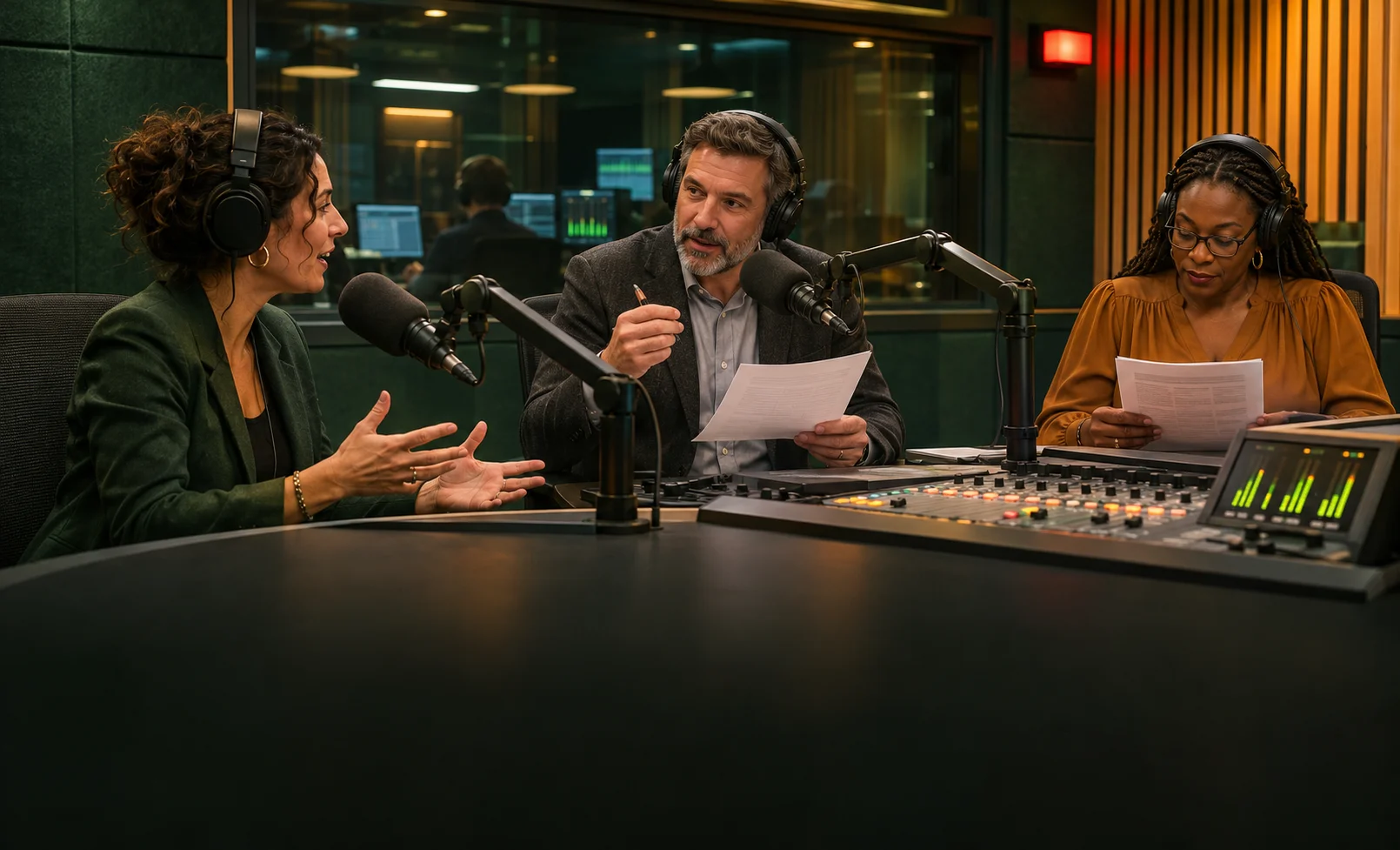
MayaYou’re visiting a new neighborhood, and you need to find a small café. Someone gives you directions: “Go straight, then turn left.” But where should you turn? A clear landmark can make that answer easier to follow. This is Real Life English on Slow English FM. We explore useful conversations and language for everyday situations. Today, we’ll practice asking for directions, checking a landmark, and repeating the route back to make sure you understood.
AlexLet’s imagine a conversation. This is an original example, not a recording of real people. A visitor is standing near a library and wants to find a café called Green Table.
AlexExcuse me. Could you tell me how to get to Green Table café?
MayaOf course. Walk straight ahead until you reach the fountain. Then turn left. The café is across from the post office.
AlexSorry, did you say the fountain or the library?
MayaThe fountain. It’s the large fountain in the square, just past the library.
AlexThanks. So I walk straight to the fountain, turn left, and look for the café across from the post office. Is that right?
MayaThat’s right. You’ll see the café on your right, across the street from the post office.
AlexGreat, thank you.
MayaThat small exchange uses a helpful pattern: ask, listen, and check. The visitor asks for directions, asks again when one detail is unclear, and then repeats the route in their own words. The other person confirms the final version.
AlexRepeating the route back is sometimes called repeat-back. In healthcare, the Agency for Healthcare Research and Quality describes check-back, also called repeat-back, as a closed-loop way to verify information. The person receiving a message acknowledges or repeats it, and the person who gave it confirms whether it was understood. That is guidance for healthcare communication; it does not show that the same method improves street directions.
MayaStill, the idea gives us a practical phrase for this conversation: “So I go straight to the fountain, turn left, and look across from the post office?” It gives the other person a chance to correct a detail before you set off. You can also ask a focused question: “Is the fountain before or after the library?” or “Do I turn left at the fountain?”
AlexLandmarks can help make directions concrete. A landmark is a recognizable place or object, such as a fountain, a station, or a large shop. Instead of relying only on a distance—“walk two hundred meters”—you can ask, “Is there a landmark I should look for?”
MayaThere is research on landmarks in different settings, but the details matter. In a real-traffic field trial, 48 people drove an unfamiliar, complex city route. The study abstract reports that good landmarks in spoken navigation instructions improved navigation and driving performance, as well as driver confidence just before turns, compared with poor landmarks or distance information. That was a driver study, not a direct test of people asking for walking directions.
AlexA separate small study looked at the start of walking routes. It compared 18 adults with acquired brain injury with matched controls as they followed written directions at four locations. Both groups performed equally well with landmark directions, and everyone preferred them. The brain-injury group made more errors and hesitated more with cardinal directions—north, south, east, and west—or left-and-right directions. Those findings concern this specific sample and study task; they don’t tell us that every person will find landmarks easiest in every situation.
MayaAnd what do people include when they give directions? A 2018 study asked 33 college students to give directions to campus buildings for a fictitious listener. Students most often mentioned landmarks, followed by cardinal directions and left-and-right details. When they were doing a second task that used visual and spatial attention, they gave significantly fewer spatial details than in the control condition. In a verbal-task condition, they gave marginally fewer. This describes how students gave directions under those study conditions; it doesn’t prove the best way to give directions in everyday life.
AlexFor everyday use, the conversation can stay simple. First, say where you want to go. Then listen for a clear starting point and a landmark. If a detail is unclear, ask about that detail. Finally, repeat the route briefly: “So I turn right at the station, and the shop is beside the bank?”
MayaUseful questions include, “Which way should I turn?” “What will I see at the corner?” and “Is it next to the station?” If the answer comes quickly, it’s fine to say, “Could you say that a little more slowly, please?” A good check is short and specific. You don’t need to repeat every word—just the part that helps you find your way.
AlexLet’s try one last example. “Go past the bakery, then turn right at the traffic lights. The museum is beside the park.” You could check: “Past the bakery, right at the traffic lights, and beside the park?”
MayaAnd the other person can confirm: “Exactly.” If one part is wrong, they can correct it. Asking, listening, and checking can help keep a conversation clear—even when you’re in a new place.
AlexYou’ve been listening to Real Life English on Slow English FM, where everyday situations help us explore useful language. Thanks for joining us.