
















Philae’s Bumpy Landing on a Comet
· 3:17
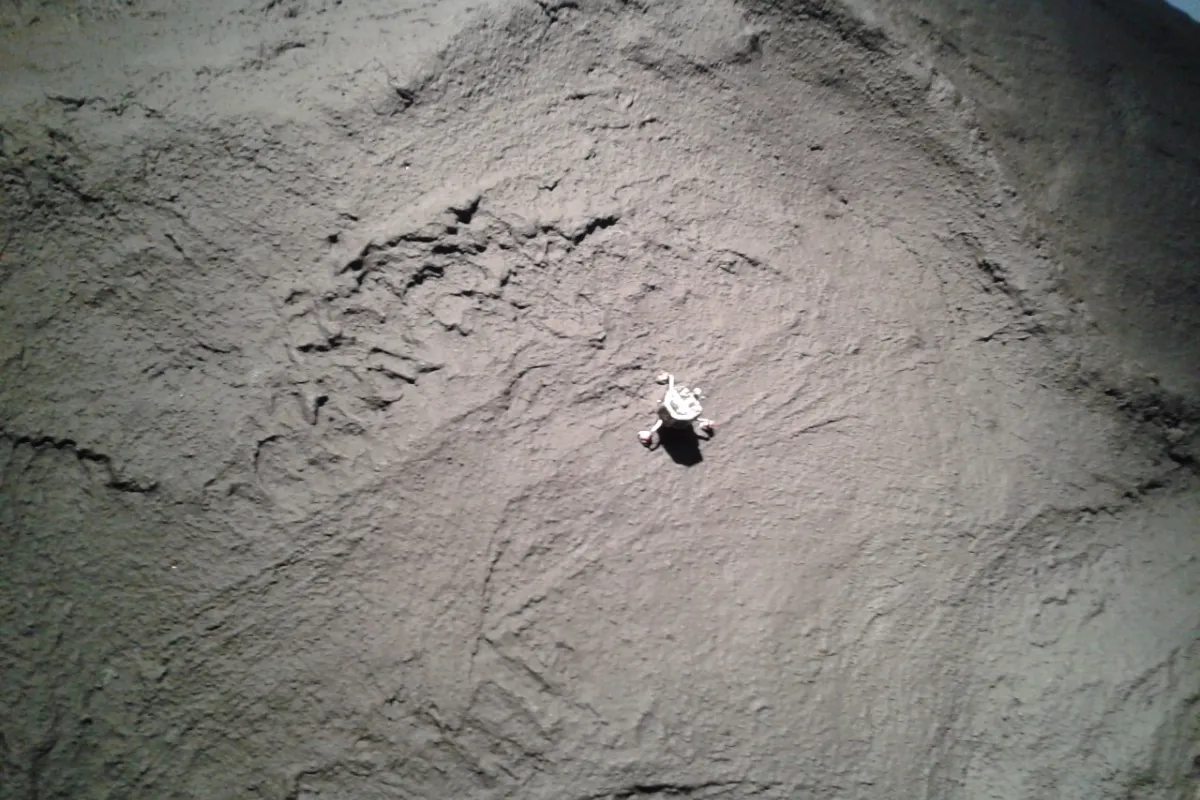
Image: Tine · CC BY-SA 4.0 · Source and licence
On November 12, 2014, a small spacecraft named Philae reached a comet. It was the first landing on a comet, but it was not the gentle touchdown its team had planned.
Transcript
You’re listening to Today in History on Slow English FM, where we make important moments in the past clear and interesting. On November 12, 2014, a small spacecraft named Philae reached a comet. It was the first landing on a comet, but it was not the gentle touchdown its team had planned.
Philae was the lander on the European Space Agency’s Rosetta mission. Rosetta also had an orbiter, a spacecraft that circles an object and studies it from above. It reached comet 67P/Churyumov–Gerasimenko in August 2014. On November 12, it released Philae to descend to the surface. The comet was a small, fast-moving target, so Rosetta had to match its speed carefully. During its approach, it slowed its speed relative to the comet by about 775 meters per second. Philae was released about 20 kilometers above the surface and descended at less than one meter per second.
Philae was supposed to anchor itself with harpoons and ice screws. A thruster was meant to push it down and help prevent a bounce. But the thruster could not be activated, and the harpoons did not fire. Philae touched down, bounced, and eventually settled at a different location. In total, it made contact with the surface four times.
Those unexpected contacts still gave scientists useful measurements. At the first site, Philae detected a soft layer above harder material. At another contact, its imprint in a boulder revealed that the icy, dusty material had about 75 percent porosity. Porosity means the share of a material’s volume made up of empty spaces. In other words, the boulder’s interior was surprisingly porous.
Philae also sent radio waves through the comet to Rosetta. Those measurements indicated that the comet’s interior was a loosely packed mixture of dust and ice, with 75 to 85 percent porosity. The lander completed about 80 percent of its planned science work during the 64 hours after it separated from Rosetta, before it entered hibernation.
Rosetta kept studying the comet for about two years. In August 2015, 67P reached perihelion—the closest point to the Sun in its orbit. The mission ended on September 30, 2016, when Rosetta made a controlled touchdown on the comet. The mission’s orbiter and lander had both reached the surface, but in different ways: Philae made the first comet landing, while Rosetta completed its long study with a planned descent.
That’s Today in History on Slow English FM. Stay with us for more stories that bring the past into focus.
Vocabulary in this episode
- spacecraft
On November 12, 2014, a small spacecraft named Philae reached a comet.
A spacecraft is a vehicle made to travel in space.
- spacecraft
Rosetta also had an orbiter, a spacecraft that circles an object and studies it from above.
Here, a spacecraft is a vehicle designed to travel in space.
- touchdown
It was the first landing on a comet, but it was not the gentle touchdown its team had planned.
A touchdown is the moment when a vehicle lands on a surface.
- touchdown
The mission ended on September 30, 2016, when Rosetta made a controlled touchdown on the comet.
Here, touchdown means Rosetta’s landing on the comet.
- orbiter
Rosetta also had an orbiter, a spacecraft that circles an object and studies it from above.
An orbiter is a spacecraft that travels around another object in space.
- orbiter
The mission’s orbiter and lander had both reached the surface, but in different ways: Philae made the first comet landing, while Rosetta completed its long study with a planned descent.
Here, orbiter means the spacecraft that studied the comet while circling it.
- relative to
During its approach, it slowed its speed relative to the comet by about 775 meters per second.
Relative to the comet means compared with the comet’s speed.
- anchor
Philae was supposed to anchor itself with harpoons and ice screws.
To anchor itself means to hold itself firmly in place.
- thruster
A thruster was meant to push it down and help prevent a bounce.
A thruster is a device that pushes a spacecraft in a direction.
- thruster
But the thruster could not be activated, and the harpoons did not fire.
Here, the thruster is the device meant to push Philae down.
- settled
Philae touched down, bounced, and eventually settled at a different location.
Settled means came to rest in one place.
- imprint
At another contact, its imprint in a boulder revealed that the icy, dusty material had about 75 percent porosity.
An imprint is a mark or shape left when something presses against a surface.
- porosity
At another contact, its imprint in a boulder revealed that the icy, dusty material had about 75 percent porosity.
Porosity is how much of a material is made up of empty spaces.
- Porosity
Porosity means the share of a material’s volume made up of empty spaces.
Here, porosity means the part of a material’s total space that is empty.
- porosity
Those measurements indicated that the comet’s interior was a loosely packed mixture of dust and ice, with 75 to 85 percent porosity.
Porosity here describes how much empty space there was inside the comet.
- loosely packed
Those measurements indicated that the comet’s interior was a loosely packed mixture of dust and ice, with 75 to 85 percent porosity.
Loosely packed means the dust and ice were not pressed tightly together.
- perihelion
In August 2015, 67P reached perihelion—the closest point to the Sun in its orbit.
Perihelion is the point in an orbit where an object is closest to the Sun.